From the land of Prophet Mohammad, A man called Ibn Saud rose to power and shook the world’s balance of power. He is also credited with the unification of the Arab states, one of which was earlier ruled by his ancestors till 1891 when one of the rival groups took it from them. He lived in exile for a decade in Qatar and Kuwait. In 1902 after capturing Riyadh, he started his expedition of Arab unification as revenge. It took him another 30 years to become victorious and to get the entire Arab peninsula under his singular control. Finally, in Sept 1932 he founded the “Kingdom of Saudi Arabia”. A new powerhouse of world geopolitics!
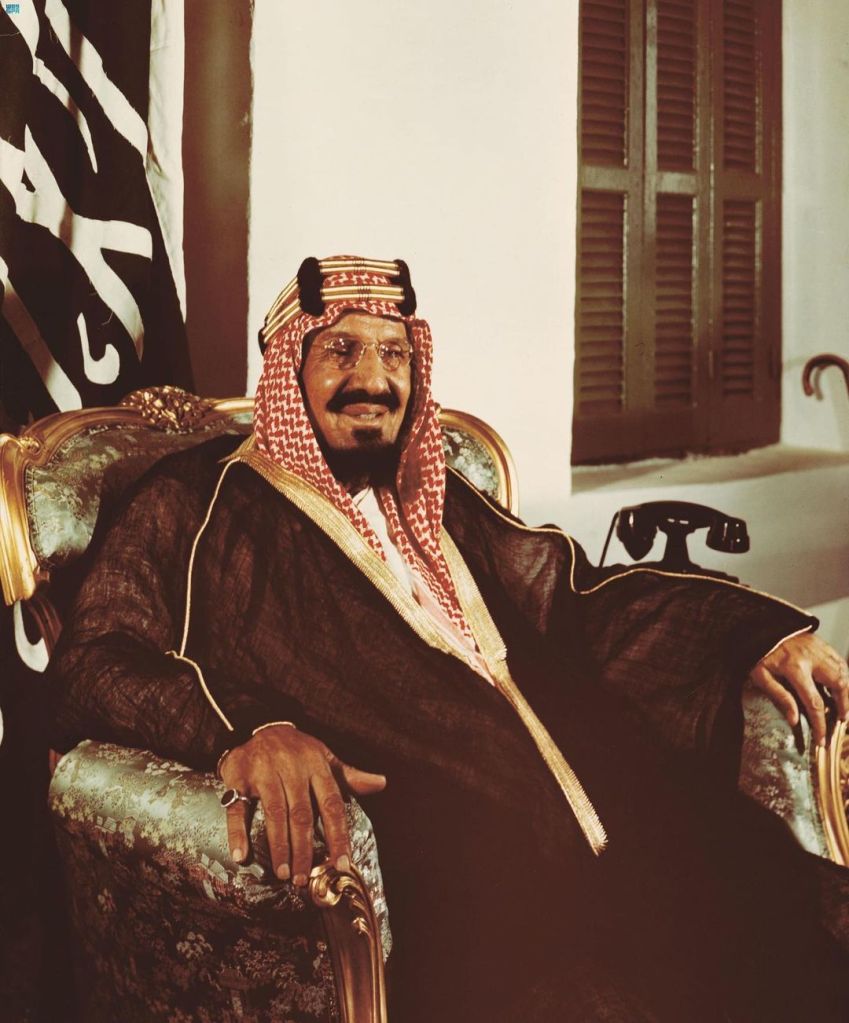
Ibn Saud: Founder of Saudi Kingdom
At that time, Western companies were waiting for this kind of stability in the region and immediately next year after founding the kingdom, in 1933 the King granted the rights to explore the oil to SoCal i.e. Standard Oil of California, a demerged company from Standard Oil in 1911. They struck “black gold” on one fine day in 1938 and oil started flowing from the wells of ARAMCO (Arabian American Oil Company), a newly formed Joint Venture between SoCal and Saudi Govt.
After that day the kingdom never looked back. They had found a machine to print money and buy influence on the world stage. They were holding nearly 16% of the oil reserves of the world. Eventually, the US’s dependence on Saudi oil made Saudis the most important ally of the USA. Which is also the case in today’s age. Other Arab countries also started earning the oil money. These countries were mostly ruled by dynasties with little democratic values. Those few families controlling the power got filthy rich from the share of oil money that was coming their way. But their greed for money exceeded their current earnings. Apparently, this money was not enough to quench their thirst!
From the revenue that these oil companies were generating, the Governments of the respective countries received a small share as “Royalty”. In the post-World War II era, they demanded to increase this share, which affected the profitability of the companies. If not agreed then such companies were threatened to be nationalised. Oil companies resisted it, but some surrendered and agreed to increase royalties. But the greed never stopped and again even more unreasonable demands were kept in after some years. This eventually led to a spree of nationalisation of “Western-Arab oil companies”. This period also coincided with the Islamic revolution in the 1970s fuelling the anti-west sentiment in the Arab world. Till the 1980s every major Arab oil producer was nationalised and was being operated by Govts.
Due to all these events, it became even more important for those governments to understand the markets, strategize actions and most importantly, coordinate oil production and fix the prices in a systematic manner. To make this all possible there was a need for a collaborative effort from all the countries to bring uniformity in prices, production and functioning.
Here enters the person whom I mentioned at the start of the first blog, “Sheikh Ahmed Zaki Yamani”. He served as “the petroleum and mineral resource minister of Saudi Arabia” from 1962 to 1986 (24 years!), born in 1930 in the holy town of Mecca, he rose through the Saudi ranks pretty fast after his education in Cairo, New York University and Harvard. His major achievements include enforcing an oil embargo in 1973 which forced oil prices to double within a meagre of two years, and negotiating the nationalisation of Saudi Arabia with American counterparts but the most important of his work has to be the formation of OPEC.

The Organisation of Petroleum Exporting Countries or OPEC as it is called, was founded in 1960 in the Baghdad convention by 5 founding countries and currently has 12 members. It is responsible for important decisions such as How much oil to produce? What price to be charged for crude oil? Whom to export to and most importantly whom not to? etc. This organisation acts as a flag bearer in matters of policy framing. These countries control 40% of oil production and 80% of the oil reserves of the entire world, just imagine the influence this body has over our day-to-day functioning. Due to all such decisions taken, OPEC has turned out to be a great facilitator for the member countries, which is evident from their economic performance which we see today.
All the oil prosperity was contributing to the success of a handful of countries at the cost of loss of revenue for other oil-producing nations and increased costs for oil-importing countries such as the US, China, and India. Some of them retaliated and in the following decades, some chances for establishing the balance of power emerged. This unrestricted use of oil gave birth to a new phenomenon of global warming and climate change. These factors were about to challenge the balance of power. How? We’ll explore this in the next part.
See you in the third and final part! Stay tuned!
Image courtesy: Wikimedia, Bloomberg / New York Daily archives/ Getty Images

 Sarthak's Musings
Great stuff with such good insights, well written,🤝
LikeLiked by 1 person
Glad to hear! Hope you’ll like the third one also!
LikeLiked by 2 people