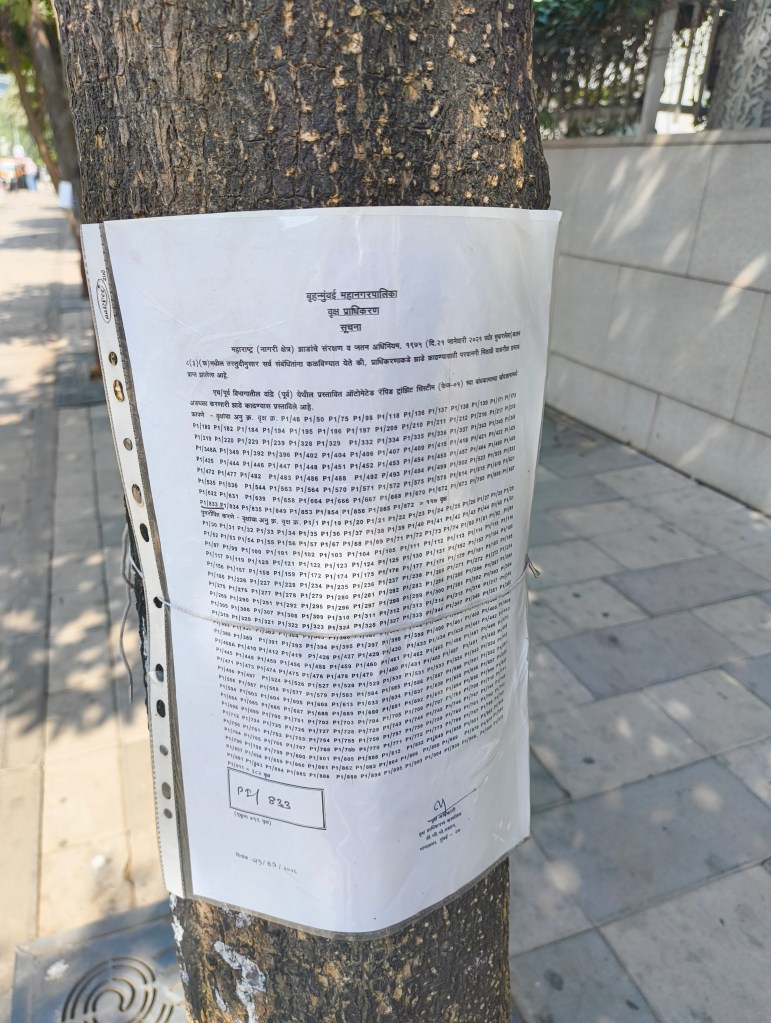
While strolling on the footpaths of BKC near Jio World Plaza, I couldn’t help but catch a few notices attached to the barks of small trees and bushes planted on the footpath. They were giving the information regarding an intimation received by the Trees Authority, BMC, from MMRDA (the nodal agency responsible for infrastructure projects in and around MMR). It was regarding cutting and replantation of around 499 trees in BKC and areas around it to make way for the “Automated Rapid Transit System” popularly known as “Pod taxi”. Nearly every tree that I saw there had such notices stuck on it. I knew about this project, but was not aware of the cutting of trees on such a scale. Seeing it with my own eyes took me on a deep thought ride. Tried to pen it down here, we’ll go one by one, why it is needed, how infra projects are approached in India, why Pod Taxi and is there any other way around?
Bandra Kurla Complex stands as a pinnacle of financial infrastructure, not just in Mumbai but for India. Only the addition of an IFSC would complete its growth trajectory (Topic for some other day). It houses numerous BFSI companies and regulatory authorities alike. These 370 hectares of area were developed on reclaimed land over marshlands in the last 20 years. It has been a badge of honour for the Mumbai Metropolitan Regional Development Authority (MMRDA). It conceptualised and developed the plots, leased them, and also currently maintains the well-being of public places in it. Various companies in BKC currently employ nearly 3-4 lakh employees. Luckily, it sits at a very comfortable distance from existing local lines, i.e. 3 kms from Bandra station on the Western line and equidistant from Kurla station on the Central and Harbour line. They act as major hubs drawing people from every corner of this city of dreams. Local trains, though crowded, are a lesser worry for the commuters; a real struggle awaits after this. Last mile connectivity!
Last-mile connectivity is equally important as all mass transit systems are. Normally in Mumbai, that gap was effectively filled by rickshaws at the railway station, charging a fixed sum of money for predetermined stops. This seems to work until now! Whoever has gone through this struggle would surely talk about the chaos the sheer number of rickshaws creates during all this. Various railway stations like Dadar, Thane, Ghatkopar, Andheri, Kurla, Bandra seem to be filled with a sea of yellow and black rickshaws during the peak hour. On any given day, they might have 400-500 vehicles in the premises going from here and there, missing pedestrians by millimetres, honking endlessly, which makes a perfect recipe for anyone to lose their temper. Even newer stations and employment hubs like Ghansoli and Airoli are seeing such chaos every day. I am a regular firsthand witness to this disarray.
This is where “Pod Taxi” or “Automated Rapid Transit System” comes into the picture. Let me explain, these are small pods or coaches carrying approximately 5-10 passengers running on dedicated tracks. As the system is based on an elevated track, it won’t add to the existing traffic on the ground. These are driverless automatic people movers with a maximum speed of 40 kmph and a frequency of 30 seconds. Pods decide their route based on the desired location of the passenger, which offers flexibility and reduces wait time at the same time. Separate track & dynamic route plan. As a metro feeder system, these features are very desirable to have. MMRDA has tied up with a firm called “Ultra PRT”, which has experience of operating a similar system at Heathrow Airport. MMRDA has a plan to build a network of around 9 kms with 38 stations across BKC, covering major areas like Diamond Bourse, RBI office, US consulate, NSE junction, Kalanagar along Bandra and Kurla railway stations, etc.
As promising as these ambitions look on paper, the timely implementation will be nothing short of a miracle. First thing, getting this system built up on the busy streets of Kurla and Bandra will be a herculean task. These roads are already dug up for the construction of the Mumbai Metro line 2 (Yellow line). Starting a new construction project here will add to the delay. Secondly, the current use of pod taxis is very limited and in very controlled areas such as airports. Also, none of the existing systems’ daily ridership goes even near 1 lakh per day. It raises honest questions whether it will be able to handle 2-4 lakhs passengers each day? Third is the factor of frequency and complexity in the operations. If we consider 2 lakh passengers each day equally from both local stations with a 10-seater pod running every 30 seconds, we will need 20 pods, leaving each half minute. Imagine this: 20 pods leaving stations in dynamic directions. In my opinion, this might be the biggest chokepoint in the making. I am happy to be proven wrong. Lastly, do not forget the cost point. The total cost of the Pod taxi is estimated at INR 1,000 crores. That comes at INR 100 cr per km. Our metro systems get built at a per km cost of 200-250 crore with much wider ridership.
The Pod Taxi project is a classic example of how big-ticket infra projects get approached in India. Mumbai will see it for the second time after the Monorail. Monorail is a prime lesson of what happened when we bet on a transport system which is not widely accepted & have very limited OEMs. Mumbai Monorail has faced multiple accidents, operational issues and is currently suspended. A few months ago, I travelled on those coaches. I was thankful that they didn’t get stuck in between. They were sounding terrible. Limited existing systems and undercapacity of manufacturing components make the situation of upgradation and regular maintenance even worse. We can also remember the example of “Skybus in Goa”. Trials turned into a fatal accident for the technicians on that coach. We have seen such flashy projects being chased quite frequently. Ropeway in Varanasi, 20 kms tunnel from Yerwada to Katraj, to name a few.
Apart from these projects being flashy and ambitious, they seem to miss the one most fundamental thing. We have almost forgotten how to make our existing systems better and how to achieve sustainable and equitable transport solutions. I need not remind everyone about the dire situation of local trains and BEST buses. Local trains always seem to be overcrowded, and the buses are never on time. Timely upgradation of the signalling system to KAVACH would enable us to increase the frequency of trains. Development of infrastructure like dedicated corridors and overbridges will help us in separating suburban railway and main railway tracks, reducing the stoppages for giving passage to the long-haul express trains. Moving towards 100% airconditioned coaches will provide a respectable commuter experience. Not to forget the elephant in the room, Bus transport. Mumbai today moves on fewer than 2800 buses, significantly lower than 4000 buses 15 years ago. Buses should be treated as go-to last-mile connectors, but we are conveniently ignoring this workhorse. New buses were not introduced promptly, and bus routes were reduced in frequency. The situation is worsening day by day!
To address our topic, which started this conversation, I am not an expert in public planning, but in my opinion, the following plan will suffice for BKC woes. Firstly, we need more frequent buses from both railway stations and even better bus connectivity once you get to the BKC. These buses can run at a frequency of 3-5 minutes from various entry points into BKC and make a circular shuttle. With the frequency of 5 minutes and 15-20 buses, we will be able to serve a considerable population. Secondly, I think the opening of the Yellow line of the Mumbai metro (Dahisar to Mankhurd) will largely take care of the commuters from the western suburbs and Navi Mumbai. They can easily get directly inside BKC without any hassle. This shift will also help ease the rush on Kurla as well as Bandra station. Use of the metro will only increase further after the opening of the Green line (Gaimukh to CSMT) and the Pink line (Vikhroli to Jogeshwari). Thirdly, we have to embrace walkability. Both while entering BKC and from the drop point till the desired location. Walkable areas have shown greater prospects of wide use of public transport and reduced accidents. We can develop a few pedestrian-only bridges to cross the Mithi river to enter BKC and later take the help of shuttle buses to get to the desired places. These are some of the suggestions that I feel will help in easing out the current traffic choke that happens every day in BKC.
Pod-Taxi offers an innovative solution to the dire problem faced by many Mumbaikars. But the complexity of the project and its operations might not result in the utopian future that we are envisaging presently. Instead, we can address this by a multi-pronged approach anchored by Bus transit, the Metro system and walkability. Many times, success is better achieved through collaboration and synergy rather than a lone performer. We can all hope for equitable and sustainable transport solutions running through our city of dreams. Can’t wait to be a commuter of such a cosmopolitan.


Valuable insights! Thanks for sharing💯👍🏻
LikeLike